
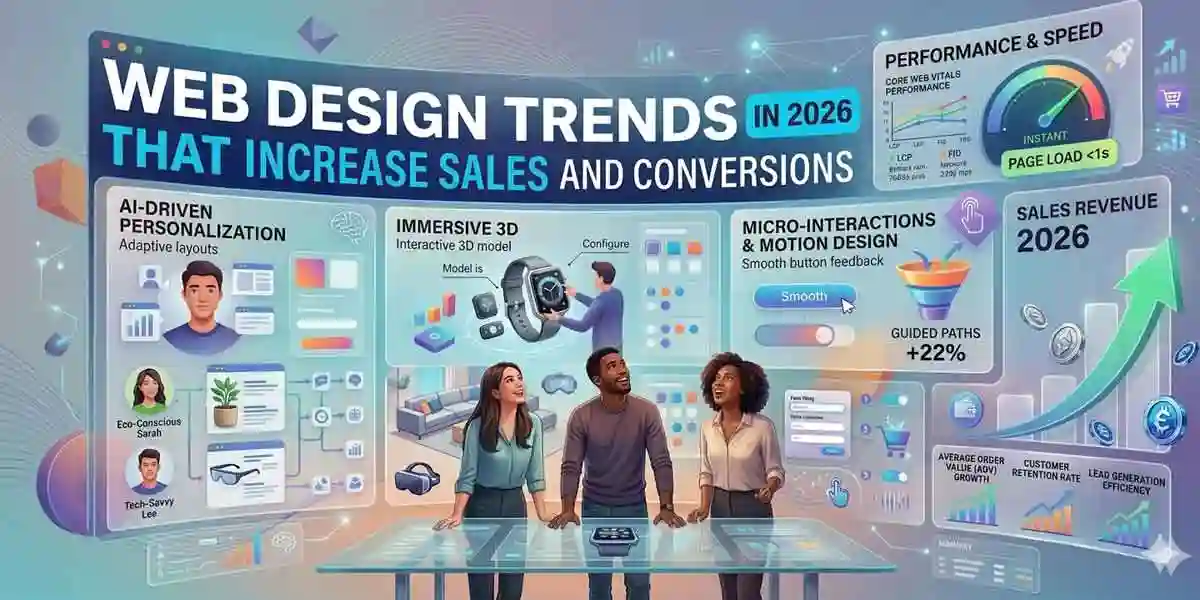
Your website has roughly 7 seconds to convince a visitor to stay. In 2026, that window is getting even smaller — and businesses ignoring the latest web design trends in 2026 are quietly losing thousands of dollars in potential revenue every single month.
Think about the last time you visited a website and instantly clicked away. Slow loading, confusing layout, tiny text on mobile — any of these can cost a business a real customer. Now flip it: when was the last time a website felt so smooth, clear, and trustworthy that you reached out or made a purchase almost immediately?
That feeling is not accidental. It is the result of intentional, conversion-focused web design.
In this guide, we will walk through the top web design trends in 2026 that are proven to increase sales, reduce bounce rates, and turn casual visitors into paying clients. Whether you run a local shop, an ecommerce store, or a professional services company, these insights apply directly to your business.
TABLE OF CONTENTS
- Why Web Design Directly Impacts Your Revenue
- Top 7 Web Design Trends in 2026 for Higher Conversions
- Old vs. Modern Design: A Clear Comparison
- Common Web Design Mistakes That Cost Businesses Money
- Recommended Tools and Platforms
- Frequently Asked Questions
- Conclusion
Why Web Design Trends in 2026 Directly Impact Your Revenue
Most business owners think of web design as a cosmetic concern — colours, fonts, and logos. In reality, design is a sales tool. Every layout decision, every button placement, and every page load second has a direct influence on whether a visitor converts into a customer.
Consider these facts. Users form a first impression of your website in under a second. A one-second delay in page load time can reduce conversions by 7%. And 75% of users judge a company’s credibility based on its website design alone.
For small and medium businesses, a poorly designed website is not just an aesthetic problem — it is a revenue leak. The good news is that fixing it pays for itself quickly.
Top 7 Web Design Trends in 2026 for Higher Conversions
1. AI-Personalized User Experiences
Websites in 2026 are moving beyond one-size-fits-all. AI-powered personalization tools now allow websites to display different content, CTAs, and product suggestions based on user behaviour, location, and browsing history.
An ecommerce store visitor from Lahore sees locally relevant deals. A returning visitor sees items based on their last browsing session. This kind of tailored experience dramatically improves time-on-site and purchase intent — and it is no longer exclusive to large enterprises. Businesses of all sizes can implement it through smart plugins and platforms.
2. Ultra-Fast, Mobile-First Design
Mobile traffic now accounts for more than 60% of global web visits. Google’s Core Web Vitals remain a critical ranking signal in 2026, meaning your website must load fast, respond instantly to touch, and display perfectly on every screen size.
Businesses that invest in performance-first design see measurable drops in bounce rates and measurable increases in leads. If your site loads in over 3 seconds on mobile, you are already losing potential customers to faster competitors.
3. Minimalist, Conversion-Focused Layouts
Clutter kills conversions. The highest-performing websites in 2026 use generous white space, clear typography hierarchies, and single focused CTAs per section. When visitors are not overwhelmed by choices, they are far more likely to take the one action you want them to take — call you, fill in a form, or complete a purchase. Less is truly more when every element on the page has a clear purpose. This is exactly what professional web design delivers — intentional layouts built around your business goals.
4. Trust-Building Design Elements
Social proof is now woven directly into design. Strategically placed client reviews, verified badges, case study snippets, and real team photos have replaced generic stock imagery on professional websites.
Visitors want to know: is this business real and reliable? Trust signals placed near contact forms and pricing sections significantly increase form completions. For service businesses, clinics, real estate firms, and B2B companies especially, this single change can make a dramatic difference in lead quality and volume.
5. Dark Mode and Adaptive Color Themes
Offering a dark mode option has moved from a nice-to-have feature to an expectation for professional websites in 2026. Adaptive themes that automatically adjust to the user’s system preference signal modernity and attention to detail.
For tech companies, SaaS platforms, and digital agencies, this also enhances brand perception among younger and tech-savvy audiences who expect a premium experience.
6. Micro-Interactions That Guide User Behaviour
Subtle animations — a button that gently pulses, a form field that highlights on focus, a progress indicator during checkout — these micro-interactions guide user attention and reduce friction at key moments.
Done correctly, they feel invisible and natural. They quietly tell the user “you are on the right path,” which reduces anxiety at critical conversion points like form submission or payment processing.
7. Accessible and Inclusive Design
Accessibility is no longer optional in 2026. Both Google and users expect websites to work for people of all abilities. Proper contrast ratios, keyboard navigation support, alt text for images, and readable font sizes not only improve usability for everyone — they also positively impact SEO and reduce legal risk for businesses operating in international markets.
💡 Featured Snippet: The most effective web design trends in 2026 combine speed, personalization, trust-building elements, and clean minimalist layouts to increase sales conversions — not just visual appeal.
Old vs. Modern Web Design in 2026 — A Clear Comparison
| Design Element | Outdated Approach | 2026 Best Practice |
| Page Speed | 5+ second load time | Under 2 seconds (Core Web Vitals) |
| Mobile Layout | Scaled-down desktop version | Designed mobile-first from scratch |
| CTAs | Multiple competing buttons | One clear, prominent CTA per section |
| Social Proof | Absent or hidden in footer | Embedded near conversion points |
| Imagery | Generic stock photos | Real business photos and team visuals |
| Personalization | Same content for all visitors | Behaviour-driven dynamic content |
| Accessibility | Not considered | WCAG 2.2 compliant by default |
Achieving every item in this table requires both strong web design and solid web development working together as one solution
Common Web Design Mistakes That Cost Businesses Money
Even businesses with budgets for professional design often fall into the same costly traps. Here are the most damaging mistakes seen in 2026:
No clear value proposition above the fold — visitors do not immediately understand what you offer or who it is for.
Too many navigation menu items — overwhelming users causes decision paralysis and higher bounce rates.
Contact forms with too many fields — each extra field you add reduces form completion rates significantly.
No mobile-specific optimization — responsive design and mobile-first design are not the same thing, and the difference in results is significant.
Slow page speed from un-optimized images and bloated plugins — this is especially critical for WordPress websites with too many active plugins.
Inconsistent branding across pages — fonts, colours, and tone that vary across your website erode visitor trust and credibility.
Sending paid ad traffic to a general homepage — this wastes your entire ad budget. Every campaign needs a dedicated, focused landing page.
Recommended Tools and Platforms for Modern Web Design in 2026
Design and Prototyping
Figma remains the industry standard for UI/UX design and client collaboration. Adobe XD and Framer are strong alternatives for teams that need interactive prototyping built into their workflow.
Development Platforms
WordPress powers over 40% of the web and remains the most flexible platform for business websites, blogs, and ecommerce stores. If your business needs something beyond a standard platform — a custom portal, booking system, or web application — our web development services are built exactly for that combined with a well-coded custom theme or a builder like Elementor, it offers both design freedom and performance control.
For ecommerce specifically, WooCommerce and Shopify continue to be the dominant platforms in 2026. The right choice depends on your product type, volume, and customization needs.
Performance Optimization
Google PageSpeed Insights and GTmetrix are essential free tools for identifying speed issues on your current website. For hosting, managed WordPress solutions like Cloudways or WP Engine deliver significantly better performance than standard shared hosting for business websites. The technology stack and hosting environment your website runs on is a web development decision that directly affects your design performance
Conversion Rate and Analytics Tools
Hotjar and Microsoft Clarity provide heatmaps and session recordings that reveal exactly where users are dropping off on your pages. Google Analytics 4, combined with proper goal tracking, shows which design elements and pages are driving real business outcomes.
Frequently Asked Questions
How often should a business redesign its website?
Most businesses benefit from a full redesign every 2 to 3 years and minor updates — new content, speed improvements, CTA testing — on an annual basis. If your website is over 4 years old, it is almost certainly hurting both your conversions and your Google rankings.
Does web design really affect Google rankings?
Absolutely. Google’s Core Web Vitals — which measure loading speed, interactivity, and visual stability — are direct ranking factors. A slow or poorly structured website will rank lower than a fast, well-designed competitor even when the content quality is similar.
What is the difference between responsive design and mobile-first design?
Responsive design adapts a desktop layout for smaller screens. Mobile-first design starts with the mobile experience and builds upward toward larger screens. In 2026, mobile-first is the correct approach because most users visit on phones first and Google indexes the mobile version of your site for rankings.
How much does a professional business website cost in 2026?
Costs vary based on complexity and requirements. A basic professional WordPress website can start from $500 to $1,500. A custom-designed, conversion-optimized business website with full SEO setup typically ranges from $1,500 to $5,000 or more. The return on investment, however, far exceeds the initial cost for any business that relies on online leads.
Can I improve my existing website without a full rebuild?
Yes. In many cases, targeted improvements — faster hosting, image optimization, a cleaner homepage layout, stronger CTAs, and added trust signals — can deliver significant conversion gains without a complete redesign. A professional website audit is the best starting point to identify your highest-impact opportunities.
What makes a landing page different from a regular website page?
A landing page is designed for one single, focused action — a form submission, a call booking, or a product purchase. It removes distractions like navigation menus and directs the visitor entirely toward converting. For paid advertising campaigns, dedicated landing pages consistently outperform general website pages in conversion rate.
Conclusion: Your Website Is Your Best Salesperson
In 2026, a website is not a digital brochure — it is your most active salesperson, working 24 hours a day across every market you serve. The businesses growing fastest online are those treating web design as a strategic investment, not an afterthought.
The web design trends in 2026 covered in this article — AI personalization, mobile-first performance, minimalist conversion layouts, trust elements, and accessibility — are not just design choices. They are business decisions with measurable impact on your leads, sales, and revenue.
If your current website is not performing the way your business deserves, the gap between where you are and where you want to be is a design and strategy problem — and it is very much solvable.
Ready to Build a Website That Actually Grows Your Business?
At SeekDigit, we design and develop high-performance, conversion-focused websites for businesses across all industries. From custom web design and WordPress development to landing pages and ecommerce stores — our team builds digital experiences that generate real results.